Most people hear the word meditation and immediately picture something very specific… usually a cross-legged monk sitting in perfect silence on a mountain somewhere, looking like he hasn’t had a single intrusive thought since 1984. And because that image looks absolutely nothing like our own messy, noisy, overthinking minds, we assume meditation probably isn’t meant for people like us. People with jobs and bills and phones that never stop buzzing and thoughts that show up uninvited at two in the morning.
It also doesn’t help that meditation has collected all sorts of odd expectations over the years. Some people think it means emptying your mind, which is ironic because the moment you try to empty your mind you realise there are about eight hundred thoughts waiting to rush in at once. Others imagine meditation as a state of total calm, as if you sit down, close your eyes and instantly become peaceful and enlightened, which is not how it works for anyone, ever.
The reality is, meditation isn’t about becoming calm on cue or reaching some perfect state of zen, and it’s not a performance or a test you can fail. It’s a practice, a very human practice, of watching your own mind with a bit more curiosity and a bit less panic. In its simplest form, meditation is just noticing where your attention has gone and gently bringing it back when it wanders, which it will, repeatedly. And incidentally, that wandering isn’t a sign you’re doing it wrong; it’s actually an important part of the practice.
Once you let go of the idea that meditation has to look a certain way, it becomes something surprisingly accessible. Something that fits into everyday life and our normal (yet often chaotic) minds. Something you can explore without getting it perfect, and something that doesn’t require silence, or stillness, or some sort of dramatic inner transformation. Just a willingness to sit comfortably, breathe for a moment, and be with yourself exactly as you are.
Contents
- So… What Is Meditation Really?
- The Mind Wanders (And That’s the Whole Point)
- What Meditation Is Actually Training
- The Different Types of Meditation
- What Meditation Isn’t
- Why Meditation Feels Hard at First (And Why That’s Normal)
- The Benefits of Meditation
- How Do I Actually Start? – A Real Beginner’s Guide
- Micro-Meditations You Can Try Today
- FAQs
- Final Thoughts
So… What Is Meditation Really?
At its core, meditation is the practice of paying attention on purpose. It doesn’t have to be mystical, or dramatic, and it’s certainly not reserved for people who already have their lives neatly sorted. The only slightly awkward bit is that meditation isn’t really one single practice. It’s really a broad umbrella term for a range of practices that train attention and awareness in varying ways.
One of the simplest (and probably the most familiar to most of us) is focused-attention meditation. You choose something reliable and uncomplicated, usually the breath, and learn how to return to it when your mind inevitably wanders off. And as we’ve already touched on, it will wander, repeatedly, because minds are noisy by design.
This was actually the first type of meditation I started with, and it’s still the one I come back to most often. I think it’s such a good place to begin because there’s almost nothing to figure out. You’ve got the breath, you’ve got the wandering mind, and you’ve got the simple job of noticing when one has dragged you away from the other. No complicated technique, no wondering whether you’re doing the ‘right’ kind of meditation, and even now, if my head feels particularly chaotic or I’ve fallen out of the habit for a while, this is usually the style of practice I come back to.
But that’s only one doorway in… Some forms of meditation ask you to notice whatever comes and goes without fixing your attention on any one thing in particular. Others use a mantra, movement, visualisation, compassion, or sensations within the body. Some have deep spiritual roots, while others are practiced in a completely secular (non-religious) way. They might look different on the surface, but underneath there’s usually the same basic idea, which is becoming a little more aware of what your mind and attention are actually doing.
This is also where meditation and mindfulness can get tangled together, because people often use the words as if they mean exactly the same thing. And to be fair, they do overlap a lot, but they’re not identical. Mindfulness is about paying attention to what’s happening in the present moment with awareness, while meditation is a broader family of practices that can include mindfulness alongside many other approaches. If you want to dig into that difference in more detail, we’ve got a full guide to what mindfulness actually is, and another on the different types of meditation if you want to see just how many routes into the practice there really are.
Whatever form you choose, meditation can help to give you a little bit of space inside your own head – the kind of space in which you can notice thoughts instead of being immediately dragged around by them. You start to recognise the patterns your mind runs on, the stories it tells you, and the little thought loops it carries you on. The obvious benefit, of course, is that once you see those patterns, you’re not quite as tightly bound to them. You get a moment of choice before you react, and a sense of clarity where there used to be pure momentum.
Obviously this doesn’t mean you feel calm the whole time, and in fact, plenty of meditation sessions feel clumsy, restless, boring or downright irritating, especially at first. But the practice isn’t about achieving some immediate sense of calm; it’s about learning to pay attention with more awareness and less pressure.
And the best part is, it’s accessible to absolutely anyone. You don’t need special equipment, or silence, or perfect posture. You just need a few minutes and the willingness to sit with whatever you find, even if what you find is a bit uncomfortable at first. Because that’s where real meditation begins, not in the absence of thoughts, but in the simple act of noticing them.
The Mind Wanders (And That’s the Whole Point)
One of the biggest surprises when you first start meditating is just how loud your mind becomes the moment you try to sit still. You sit down expecting a quiet few minutes and, within seconds, you’re replaying a conversation from earlier, remembering something embarrassing from twelve years ago, wondering why your knee suddenly feels weird, debating whether you should check your phone, and then wondering why you’re even thinking about your phone in the first place… And the more you try not to think, the more your mind treats it like an invitation to throw every thought it’s ever had directly into the spotlight.
For most people, this is the moment they assume meditation isn’t for them. They think the wandering is a sign they’re doing it wrong, or that their mind is somehow messier or more chaotic than everyone else’s. But in focused-attention meditation, the wandering itself isn’t the problem. What matters is the moment you notice it.
Every time you realise your mind has drifted and you guide it back to your breath, or the body, or whatever you’re focusing on, you’re strengthening the exact mental muscles meditation is meant to build. It’s a bit like doing a rep at the gym. You wouldn’t expect your body to get stronger without movement and resistance, and your attention works in much the same way.
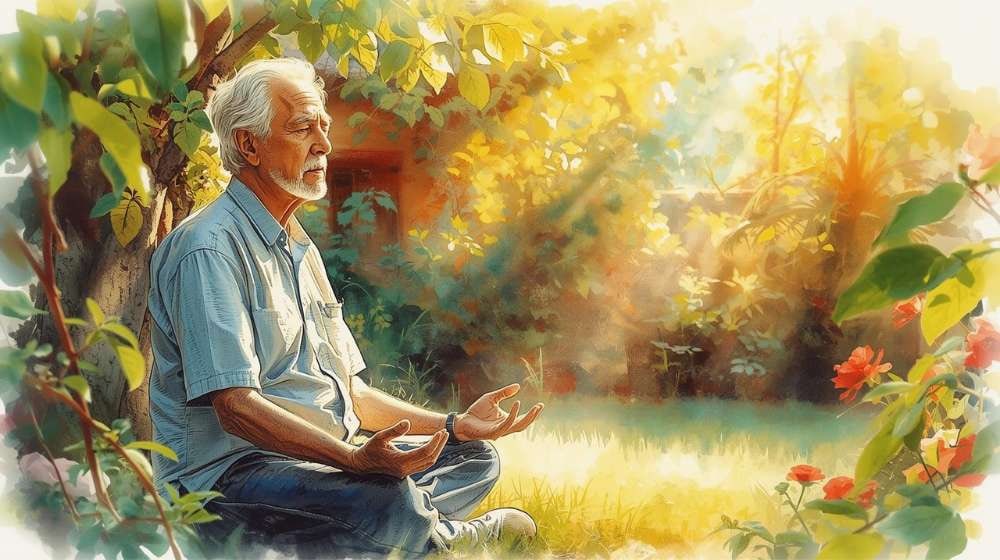
That little loop (noticing you’re lost in thought and returning to the focus of your meditation) can happen dozens of times in a single session, and every return is simply part of the practice. One of the most common meditation mistakes beginners make is assuming they’re supposed to hold their attention perfectly still from start to finish, when in reality, noticing that it’s wandered and bringing it back is exactly what you’re there to practice.
Once you understand that, meditation stops feeling like a battle, and you stop trying to bully the mind into silence. You simply watch what it does with a little more curiosity. It wanders, you notice, you come back. That’s the rhythm. No drama, no judgment, and no need to wrestle with anything.
Some days the mind will settle quickly, and other days it’ll be all over the place. Both experiences are completely normal, and both are meditation. I’m in danger of sounding like a broken record now, but the wandering isn’t getting in the way of the practice. It is the practice.
And when you stop treating your thoughts as enemies to defeat, something shifts. You’re no longer trapped inside the momentum of every idea, memory, and mental twitch that comes along. You see the movement instead of becoming it, and that small bit of distance (even a fraction of a second) makes all the difference.
What Meditation Is Actually Training
Once you realise that meditation is really just the practice of noticing where your attention goes and bringing it back, the next natural question is why this simple act makes such a difference. And the answer, thankfully, isn’t complicated. It’s just that the mind and body react to where your attention rests, and meditation gently shifts that balance in ways you can actually feel.
You’ll often hear that meditation “rewires your brain”, switches off certain brain networks or flips your nervous system from stress into calm, as though ten minutes with your eyes closed gives you access to some sort of hidden control panel behind your forehead. The reality, as usual, is a bit less dramatic.
There is research suggesting that meditation and mindfulness are associated with changes in brain activity and, in some studies, differences in areas involved with things like attention and emotional regulation. But researchers are still working out exactly what those findings mean, and even the National Center for Complementary and Integrative Health points out that the results can be difficult to interpret and their practical implications aren’t always clear.
What we can understand much more easily is the skill you’re actually practicing.
If you’re following the breath and realise you’ve spent the last thirty seconds mentally rewriting an argument from last Tuesday, you notice and come back. If a thought appears and you manage to see it as a thought rather than immediately disappearing into the story attached to it, you’re practicing awareness. If you notice irritation, boredom or an urge to reach for your phone without automatically acting on it, you’re practicing that little pause between something happening and your response to it.
Do that repeatedly and you’re spending time deliberately practicing attention rather than simply letting it run wherever it wants.
That doesn’t mean meditation turns you into some permanently calm, emotionally bulletproof version of yourself. It also doesn’t mean every meditation session will make you feel relaxed. In fact, sometimes sitting quietly makes you more aware of tension, thoughts or emotions you hadn’t noticed five minutes earlier.
I’ve always found meditation much easier to understand when I think of it as an ongoing practice rather than a switch. You’re not pressing a button that makes the brain calm down; you’re getting more familiar with where your attention goes, what tends to pull it away, and what happens when you notice all of that without immediately getting swept along with it.
The neuroscience behind meditation is genuinely interesting, and we’ve looked at the research in much more detail in our guide to the science of mindfulness. But you don’t need to understand what a particular brain region is doing to get something useful from the practice. You just need to keep noticing, and keep coming back.
The Different Types of Meditation
By the time you’ve spent even a little while sitting with your breath or paying attention to your thoughts, it’s natural to start wondering what else meditation might look like. People talk about different techniques as if they’re completely separate worlds, but in reality they’re often different routes into the same broad practice, each one offering a slightly different way of working with attention and awareness.

Focused-attention meditation is the version most of us picture first. You choose something simple, usually the breath, and keep coming back to it whenever your attention wanders off somewhere else. As I mentioned earlier, this is still the style I tend to come back to most often myself, partly because there’s so little to overthink. You’ve got the breath, you’ve got your wandering mind, and you’ve got the fairly uncomplicated job of noticing when the second one has forgotten all about the first.
A body scan works slightly differently, because instead of keeping your attention on one fixed anchor, you gradually move it through different areas of the body, noticing whatever sensations happen to be there. Warmth, pressure, tingling, tension, absolutely nothing at all… there isn’t really a particular sensation you’re supposed to find. And if focusing closely on the breath has never felt especially comfortable or natural to you, this can be a really useful alternative. We’ve got a full body scan meditation guide if you want to explore that one properly.
Then you’ve got more open styles of meditation, where you’re not necessarily trying to keep your attention fixed on one particular thing at all. Instead, you might simply notice thoughts, sounds, emotions or physical sensations as they appear and disappear, without feeling the need to grab hold of every single one and follow it wherever it happens to lead. Which, as anyone who has ever spent twenty minutes mentally arguing with someone who isn’t even in the room will know, is sometimes easier said than done.
Other forms of meditation give the mind something a little more specific to work with. Mantra meditation uses a repeated word, phrase or sound. Loving-kindness meditation deliberately works with compassion and goodwill, both towards yourself and other people. And walking meditation brings movement into the practice, which can be a much better fit if sitting still for ten minutes makes every part of you want to get up and do literally anything else.
Then there’s guided meditation, where someone talks you through the practice as you go. Personally, I think this can be one of the easiest ways to start because it removes that constant beginner question of “What am I supposed to be doing now?” You don’t have to remember a technique or keep checking whether you’re getting it right, you can just listen and follow along.
And if you’ve never actually tried one before, this is probably a better time to experience it than to keep reading about it. Below is one of our guided meditations from The Quiet Mind Lab YouTube channel, so if you’ve got a few minutes, stick your headphones on, get reasonably comfortable and give it a go.
And if you’re not sure whether you’d be better off with someone guiding you or practicing completely on your own, we’ve looked at that properly in our guide to guided vs unguided meditation.
There are plenty of other approaches too, some simple and secular, others rooted in traditions that go back hundreds or even thousands of years, and we’d be here for quite a while if we tried to squeeze all of them into this section.
The important thing for now is that there isn’t one ‘correct’ type of meditation you need to force yourself into. If focusing on the breath feels awkward, try something else. If sitting still makes you restless, walk. If practicing alone leaves you wondering what on earth you’re supposed to be doing, try a guided session.
Ultimately, the best type of meditation is usually the one that feels useful enough, comfortable enough and simple enough that you’ll actually want to come back to it.
None of them are better than any other necessarily, and none of them are more advanced. They’re simply options, and most people end up drifting between them depending on what kind of day they’ve had and what their mind feels capable of.
What Meditation Isn’t
I didn’t originally become interested in meditation because I was searching for enlightenment, trying to become more spiritual, or hoping to transform myself into someone who could sit cross-legged for three hours without moving. I actually came to it looking for a way of coping with grief, along with periods of anxiety and stress, and meditation was simply one of the things I started exploring to see whether it could help.
I think that probably shaped the way I’ve always looked at the practice, because for me it was never really about achieving some special state. It was something practical I could do when my own mind felt difficult to be around. And although my relationship with meditation has changed a lot since then, I still think stripping away some of the strange expectations surrounding it makes the whole thing far easier to approach.
Meditation isn’t about emptying your mind, for a start. The mind doesn’t work like a tap you can simply switch off, and as we’ve already established, thoughts are going to turn up whether you particularly want them there or not. Trying desperately not to think is usually a pretty reliable way of discovering just how many thoughts your brain is capable of producing.
It isn’t about feeling calm all the time either. Some sessions can be incredibly relaxing and pleasant. But others can be boring, uncomfortable or frustrating, and occasionally your brain seems determined to spend the entire session thinking about absolutely anything except the thing you sat down to focus on. Unfortunately, meditation doesn’t stop those experiences from happening.
And it certainly isn’t a spiritual badge or some sort of moral achievement, at least it shouldn’t be. You don’t have to be wise, serene, religious, vegan or living on permanent retreat. You don’t need to adopt a new personality, start speaking in whispers, or become somebody fundamentally different from the person who first sat down.
Nor does meditation need to feel magical. There can be moments that feel unusually clear or peaceful, and sometimes a session genuinely does leave you feeling noticeably different afterwards. But plenty of your meditation sessions will be incredibly ordinary. You sit, you notice, your mind wanders, you notice that too, and eventually you get up and carry on with your day.
For me, that’s actually part of what makes meditation useful. You don’t have to turn it into something bigger than it is, and you don’t have to chase a particular feeling or prove that you’re getting somewhere. You just practice, again and again, and in the process begin to understand the very nature of your own mind…
Why Meditation Feels Hard at First (And Why That’s Normal)
For most people, the first few attempts at meditation feel nothing like what they expected, and that alone can be frustrating. You sit down hoping for a few minutes of peace, and you meet a mind that seems louder than ever, full of thoughts you didn’t ask for and urges you didn’t notice during the day. You might feel restless, or bored, or oddly annoyed, as if your whole body is resisting the idea of being still for even a few minutes. None of this means you’re bad at meditation; it just means you’re having a perfectly normal experience.
Meditation can feel uncomfortable at the beginning simply because you’re slowing down enough to notice things you usually rush straight past. All the tiny tensions, anxieties and habits that go unnoticed while you’re busy suddenly have space to surface, and the mind doesn’t always know what to do with them. It can feel chaotic or disorganised, like opening a cupboard that hasn’t been sorted in years, but the chaos was always there – you’re just seeing it clearly for the first time.

There’s also the fact that stillness isn’t something we practice much in everyday life. We’re used to filling every moment with noise or distraction, and when that disappears, the mind starts looking for something to latch onto. That can create a kind of itchiness, a desire to move or check your phone or think about something more interesting. Again, this isn’t a failure; it’s just the mind adjusting to a different pace.
Doubt is common too. The little voice that says “Am I doing this right?” or “Is this even working?” or “Why does this feel so pointless?”… Meditation exposes those thoughts, but with practice, those doubts often soften. Not because the mind becomes silent but because you no longer take every thought at face value.
Sometimes the body even gets involved. A twitch, a fidget, a sudden ache in a place you didn’t know you had muscles. These sensations come and go, and your job isn’t to eliminate them, but to meet them with the same gentle curiosity you bring to everything else.
The important thing to remember is that difficulty isn’t a sign you’re meditating incorrectly. In fact, the early discomfort is often a sign the practice is doing exactly what it’s meant to do. You’re learning to sit with yourself, with your thoughts, and your body, without rushing to escape or distract yourself. That takes time, softness and a willingness to return, over and over.
Once you push through those early days, even slightly, the practice begins to feel less like a disruption and more like a small refuge, a brief moment each day where you’re not performing, or reacting, or trying to keep up. And that sets the stage for the deeper benefits of meditation, the ones that slowly weave themselves into the rest of your life without asking for anything dramatic in return.
The Benefits of Meditation
Once you get past those first awkward days of sitting with yourself, some of the benefits of meditation start to show up in small, almost unremarkable ways, the kind you might not even notice at first. You might find that you pause for a second before reacting to something that would usually annoy you, or you might notice you’re able to let go of a passing worry a little faster than usual. You might even feel a slight softening in situations that normally tighten your whole chest. None of these changes are dramatic, but they build quietly, like a slow shift in the background of your life.
One of the most consistent benefits I’ve experienced over the years is a greater sense of peace. Not constant or unshakeable, but a subtle increase in the distance between a thought and my reaction to it. Meditation teaches you to see the space that was always there, even if you didn’t realise it. And in that space, there’s room to choose how you respond instead of being dragged along by the momentum of whatever emotion happens to show up.
Some people also notice meditation helps with clarity. When your mind spends less time spinning out into old stories or imagined futures, you start to see things more clearly. Decisions feel a little easier, conversations feel less tangled, and even your own inner world feels a bit less crowded because you’re no longer giving every passing thought the same level of importance.
Then there’s the way meditation supports emotional resilience. It doesn’t stop difficult feelings from appearing, but it can help to change your relationship to them. Instead of being overwhelmed by anxiety, or frustration, or sadness, you develop the ability to sit with those emotions without collapsing into them. It’s not about pushing anything away, it’s just about learning that you can feel something fully and still stay grounded.
Many people also find improvements in focus – not because meditation magically sharpens the mind, but because you’re practicing the act of training your attention in small, consistent ways. When you spend even a few minutes each day noticing where your mind goes and guiding it back, it can help to strengthen the same mental skills you use when reading, working, listening, or trying to stay present in conversations.
And of course, there’s the effect meditation can have on stress. It doesn’t remove whatever’s causing the stress in the first place, but when you learn how to bring yourself back to the present, it can help the nervous system gradually settle, and the constant hum of tension that so many of us carry can begin to take its foot off the gas pedal.
For anyone interested in digging into the research itself, the NCCIH overview of meditation and mindfulness gives a useful breakdown of what the evidence currently supports, where results are mixed, and where more research is still needed.
None of these benefits require long sessions or perfect technique either. They emerge slowly as the practice becomes a small, regular part of your life. And once those changes begin to unfold, it becomes far easier to look at meditation not as something you’re supposed to master, but as something you can weave into your life, which is exactly what the next section is all about.
How Do I Actually Start? – A Real Beginner’s Guide
When you decide you’re ready to give meditation a real try, the good news is that you don’t need much. You don’t need special cushions, or special clothes, or a perfectly organised morning routine. You don’t even need silence. You just need a few minutes where you’re willing to slow down and see what happens, even if what happens feels a bit strange or uncertain at first.
A good way to begin is to pick a short amount of time, shorter than you think you need. Two or three minutes is plenty. Sit in whatever position feels comfortable, not the position you imagine a meditator should sit in, but the one your body naturally settles into. You can close your eyes if that feels right, or you can leave them half open. There’s no correct choice here, only whatever helps you feel most comfortable.
Once you’re settled, gently rest your attention on your breath. Not by forcing yourself to breathe in a particular way, but by noticing how it already moves. The rise, the fall, and the soft edges of each inhale and exhale. Your mind will wander almost immediately and that’s fine (it’s completely expected) but each time you notice it drifting, bring it back to the breath in the same way you’d guide a child’s attention without scolding or frustration.
If the breath doesn’t feel like a good anchor, you can rest your attention on the feeling of your hands, or the sounds in the room, or the gentle weight of your body on the chair. Anchors don’t need to be complicated or profound. They just need to be stable enough for your attention to rest on for a moment before it wanders again.

Some people find it helpful to set a timer that chimes once when the time is up, mostly so they aren’t tempted to keep checking the clock. Others prefer guided meditations, especially in the early days, because it can feel easier to let someone else hold the structure while you simply follow along. Both approaches are perfectly valid. Meditation isn’t about doing it the hard way, it’s about finding the way that feels most comfortable for you.
Starting small and staying gentle is the best way to build a practice that actually lasts. There’s no need to meditate for twenty minutes a day unless you genuinely want to. Even a few minutes, repeated consistently, can make a meaningful difference. And the more you approach the practice with curiosity instead of pressure, the more naturally it becomes part of your life.
And if you’d like a clearer sense of how all these pieces fit together, our guide on how to meditate properly breaks everything down in the most realistic way possible.
Micro-Meditations You Can Try Today
One of the easiest ways to make meditation feel like something you can actually fit into normal life is to stop assuming every practice needs to involve sitting down for ten or twenty minutes with your eyes closed. Sometimes you’ve got that time, sometimes you haven’t, and there’s still something useful about taking thirty seconds or a minute to deliberately stop whatever your attention has been tangled up in and bring it back to what’s happening around you.
I use these little pauses as much more informal versions of meditation. They’re not really a replacement for sitting down and practicing properly when I have the time, but they’re a good way of bringing some of the same skills into the bits of life where meditation usually gets forgotten.
A One-Minute Breath Pause
Probably the simplest is a one-minute pause with the breath. You don’t need to sit down, close your eyes or announce to everybody in the room that you’re about to meditate. You might be standing in the kitchen waiting for the kettle to boil, sitting in the car before you go somewhere, or taking a minute between one job and the next.
Just notice that you’re breathing.
You don’t need to slow it down or change it. Follow a few breaths as they come and go, notice where you feel them most clearly, and whenever your attention disappears into whatever you were thinking about five seconds earlier, come back again.
That’s it.
Notice What’s Already Around You
Another one I like is simply widening your attention to what’s happening around you. If your head feels particularly crowded, stop for a moment and notice a few things you can see. Then a few sounds you can hear. Then whatever physical sensations happen to be obvious, whether that’s your feet on the floor, your hands resting somewhere, the temperature of the room or the weight of your body against the surface beneath you.
You’re not trying to turn any of it into some profound mindful experience. You’re just spending a few moments paying attention to something other than the stream of thoughts that had your full attention a second ago.
And that’s really the point of these tiny practices – meditation doesn’t have to exist only inside a formal session. The same basic act of noticing where your attention has gone and deliberately bringing it somewhere else can happen while the kettle boils, before you open your laptop, after an annoying conversation or while you’re sitting in the car for a minute before going inside.
If that kind of practice appeals to you, we’ve put together a whole collection of 60-second micro-meditations you can use throughout the day without needing to clear your schedule or disappear somewhere quiet.
Sometimes a minute really is enough to practice…
FAQs
Is Meditation the Same as Mindfulness?
Not quite, although it’s easy to see why the two get mixed together. Meditation is the broader collection of practices we’ve been talking about throughout this guide, while mindfulness is specifically about paying attention to what’s happening in the present moment with awareness. You can practice mindfulness during meditation, but you can also practice it while walking, eating, working or having a conversation with someone.
Do I Need to Be Religious or Spiritual to Meditate?
Not at all. Meditation has deep roots in several religious and contemplative traditions, and for plenty of people that spiritual context remains an important part of the practice. But you don’t have to adopt any particular belief system to meditate. You can approach it completely secularly, as a way of working with attention, awareness and your relationship with your own thoughts.
Personally, that’s always been much closer to the way I’ve approached it.
How Long Should a Beginner Meditate For?
There really isn’t a magic number. If you’re completely new to meditation, two or three minutes is enough to start figuring out what the practice actually feels like, and five or ten minutes can come later if you want them to. There’s very little point forcing yourself through twenty minutes because somebody online told you that’s how long ‘proper’ meditation takes.
We’ve looked at the question in much more detail in our guide to how long you should meditate, but for a beginner, I’d always choose a short session you’ll happily repeat over a long one you immediately start dreading.
Is There a Best Time of Day to Meditate?
There can be a best time for you, but there isn’t really a universal best time for everybody.
Some people like meditating first thing in the morning because the day hasn’t had a chance to get hold of them yet. Others prefer evenings, lunch breaks or the ten quiet minutes they happen to get after everyone else has gone to bed. The useful time is generally the one you can actually protect often enough for meditation to become part of your routine.
If you’re trying to work that out, our guide to the best time to meditate goes through the pros and cons of the different options.
How Do I Know If Meditation Is Actually Working?
This is a tricky one because meditation doesn’t normally give you an obvious progress report.
You might not feel dramatically different while you’re sitting there. In fact, you might feel exactly the same. Often the more interesting signs appear elsewhere – noticing a worry a little sooner, catching yourself before an automatic reaction, realising you’ve been lost in thought, or simply finding it slightly easier to sit down and practice without turning the whole thing into a battle.
We’ve got a separate guide to the signs meditation is working because, unsurprisingly, they’re usually much less dramatic than people expect.
What If I Don’t Have Anywhere Quiet to Meditate?
Then don’t wait for somewhere quiet.
Silence can obviously make things easier, especially when you’re starting out, but it isn’t a requirement. Traffic, neighbours, people moving around the house and whatever inexplicable banging noise somebody has decided to start making outside your window can all become part of what you notice.
Our guide to meditating in a noisy environment goes into this properly, but the short version is that you don’t always have to get rid of distraction before you can practice working with it.
Is Meditation Safe for Everyone?
For most people, meditation is generally considered a low-risk practice, but that doesn’t mean every form of meditation feels comfortable or useful for everybody.
As we touched on earlier, sitting quietly can sometimes bring difficult thoughts, emotions or sensations much more clearly into awareness. If meditation repeatedly leaves you feeling genuinely distressed, overwhelmed or noticeably worse, you don’t need to force yourself through it because somebody told you discomfort means you’re ‘doing the work’. Stop, change the practice, shorten the session or seek appropriate professional support if you need it.
We’ve covered that subject much more carefully in our guide to whether meditation is safe for everyone if you’re interested in reading more about it.
Final Thoughts
The more time you spend with meditation, the more you realise it isn’t something you master or perfect. It’s something you live alongside. Some days you’ll sit down and everything will feel spacious and settled, and other days you’ll feel like your mind is hosting a small festival and nobody bothered to invite your attention to the planning meeting. Both experiences are part of the practice. The point isn’t to achieve a particular state, it’s to show up for yourself with a little more awareness, a little more patience and a little more honesty than you did the day before.
Meditation becomes easier when you stop thinking of it as a task to complete and start seeing it as a quiet companion, something you return to when you need grounding or clarity or simply a moment where you’re not being pulled in twelve different directions. It grows with you, softens with you and changes shape depending on the kind of day you’re having. There’s no need for perfection, no need for rigid routines, and no need to fit yourself into some idea of what a meditator should look like. You bring your real, messy, ordinary self to the practice, and that’s exactly who it’s for.
Over time, meditation weaves itself into the small corners of your life. It shows up in the way you pause before reacting, in the breath you take before speaking, in the calm that appears for a moment when you didn’t think calm was possible. It doesn’t announce itself with fanfare. It works quietly, patiently, shifting your baseline inch by inch until you realise you’re meeting your days with a little more peace than you used to.
And whenever you feel unsure of where to begin or how to continue, you can always let someone else guide you for a while. Our gentle guided meditations are there whenever you want a hand to hold, especially on the days when your mind feels a bit too loud to manage alone.
Meditation doesn’t ask for much. Just a few minutes, a bit of curiosity and the willingness to return, again and again, no matter how many times you wander off. It’s not a perfect practice. It’s a human one. And once you see it that way, it becomes something you can carry with you for as long as you want, a soft companion in a life that moves much too quickly.
