
Mindfulness is one of those words that appears everywhere, but what is mindfulness really, beneath all the branding and hype? You see it on wellness blogs, in YouTube thumbnails, on meditation apps and in conversations where people are nodding like they understand it but secretly thinking, “I have no idea what this actually means”. It’s often presented like a lifestyle upgrade, or a mental skill you’re supposed to possess, or something that naturally happens to calm, blissful people who eat porridge with blueberries and never get road rage.
But for most of us, everyday experience looks a lot different. You’re stirring a pot on the stove while having an imaginary argument in your head. You’re trying to fall asleep while replaying something embarrassing you said two years ago. You’re ‘listening’ to someone while actually thinking about dinner plans, or bills, or whether you’ve forgotten something important.
We go through huge chunks of life in that semi-absent state, half in the world and half in our thoughts. And somewhere buried under all that noise is the simple capacity to be present for our actual experience again.
That, really, is where mindfulness begins. It’s paying attention to what’s happening while it’s happening, whether that’s a thought, a feeling, a physical sensation or something going on around you, without immediately needing to judge it, fix it or disappear into the story your mind starts building around it.
Which sounds incredibly simple. And technically, it is.
Remembering to actually do it is the interesting part.
Contents
- So What Is Mindfulness Exactly?
- Mindfulness Versus Meditation
- What Mindfulness Feels Like in the Body
- What Mindfulness Feels Like in the Mind
- How Mindfulness Positively Impacts Everyday Life
- Common Misconceptions About Mindfulness
- Simple Ways to Practice Mindfulness Today
- The Gentle Truth About Mindfulness
So What Is Mindfulness Exactly?
We’ve already got the basic definition out the way, but the part that probably matters more is what happens after you notice what’s appearing in your mind.
Because mindfulness isn’t just being aware that a thought, feeling or sensation exists. It’s also about learning to notice what’s there without immediately getting involved with it. You don’t have to decide whether a thought is good or bad, work out where it came from, fix whatever emotion has appeared, or follow every thought wherever it’s trying to take you. You’re simply becoming aware of what’s happening before the usual machinery of reaction has completely taken over.
Which sounds almost stupidly obvious until you realise how rarely most of us actually do it. Most of the time we’re not really in the moment we’re in at all. We’re somewhere three inches behind our eyes thinking about something else, usually on autopilot, skimming through life half-aware while our mind runs a constant stream of commentary in the background. Mindfulness is really just the moment you notice that happening and come back into more direct contact with whatever you’re actually doing.
And you don’t need to adopt a ‘mindful lifestyle’, or practice ‘mindful awareness’, or buy into any of that polished self-help language. It might be as small as noticing that you’re breathing, feeling your feet on the ground, or realising you’ve been holding tension in your shoulders all morning. It can even be catching yourself halfway down a familiar train of anxious thinking and recognising, “Oh. I’m doing that thing again”.
The thought might still be there, and the anxiety surrounding it might still be there. In fact, mindfulness doesn’t require either of them to disappear. The difference is that, for a moment at least, you’re no longer completely inside the thought, and instead, you’re noticing the thought appearing.
And the good news is, mindfulness isn’t something you have to acquire like a new personality trait. It’s already something you do occasionally without really thinking about it. You catch a glimpse of your reflection and laugh at the way you look, you suddenly taste your food instead of inhaling it, or you hear someone laugh and actually stop to notice it.
Those little moments of presence already belong to you. You’re not learning something alien or especially mysterious, you’re just getting a little better at recognising when you’re here for your own life and when your mind has wandered off somewhere else.
Mindfulness Versus Meditation
Mindfulness and meditation get tangled together all the time, mostly because they overlap so much that it’s easy to assume they’re basically the same thing with slightly different names. And to be fair, sometimes they are happening at the same time. You can absolutely practice mindfulness while meditating, which is where the term “mindfulness meditation” comes from, but they’re not quite interchangeable.
Meditation is really the broader umbrella. It covers a whole range of deliberate practices, some of which involve mindfulness and some of which focus on other things entirely, like the breath, a mantra, visualisation, compassion, movement, or simply noticing whatever happens to appear. Mindfulness, on the other hand, is more about the way you’re paying attention. You’re noticing what’s happening as it happens, without immediately judging it, reacting to it, or getting completely carried away by it.
That probably sounds more complicated written down than it actually feels in real life, because mindfulness can happen absolutely anywhere. You can be standing in a queue and suddenly realise you’ve spent the last five minutes mentally rehearsing an argument that hasn’t even happened. Or talking to someone and notice that you stopped listening about thirty seconds ago because you’ve been planning what you’re going to say next.
That little moment of “Oh, hang on… where did my attention just go?” is mindfulness too.
And this is probably the easiest way I’ve found to think about the difference myself. Meditation usually gives you a more deliberate space in which to practice paying attention, while mindfulness is something that can show up anywhere, including in the middle of all the ordinary, slightly chaotic bits of daily life. You might sit for ten minutes following the breath and notice when your mind wanders, but you might also notice that same wandering while you’re answering emails, washing up, or sitting in traffic wondering why the person in front apparently needs written permission to notice the light has turned green.
That doesn’t mean meditation is just mindfulness with your eyes closed, though, because meditation is much broader than that. Some forms of meditation work directly with mindfulness, while others don’t, and if you want the bigger picture, we’ve gone into that properly in our guide to what meditation actually is.
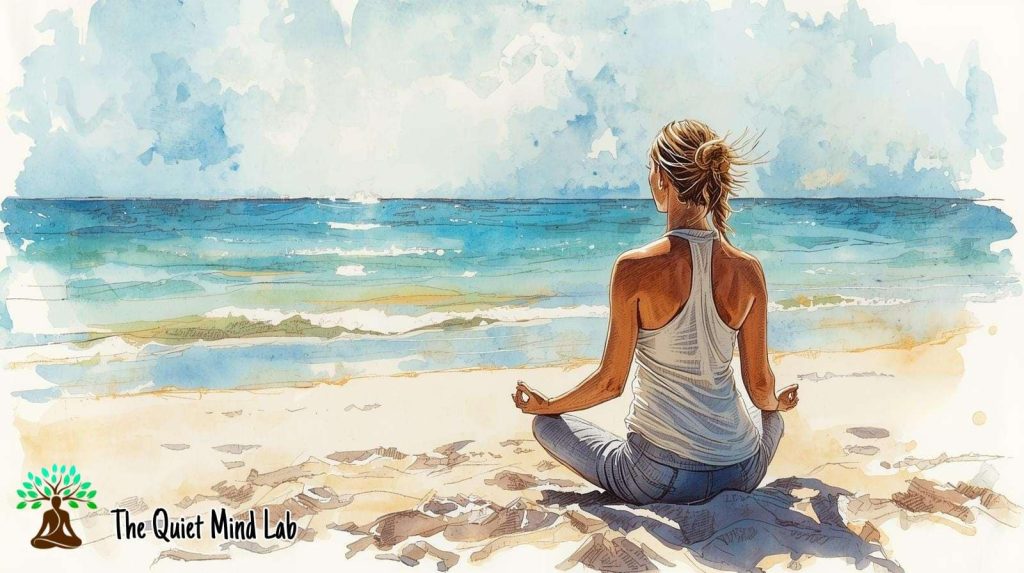
What meditation can give you is a fairly simple place to practice that act of noticing. You sit down and pay close attention to the breath, your attention wanders off somewhere else within about 10 seconds, and at some point you realise it’s happened. Then you come back to the breath. Do that often enough and the act of noticing can start to feel more familiar, which is where the connection with everyday mindfulness becomes much easier to see.
Because the same basic thing can happen away from meditation too. You suddenly realise you’ve been doomscrolling for ten minutes without really wanting to, or you notice you’ve barely heard what somebody has been saying because you were lost in your own thoughts. Nothing dramatic or even particularly obvious has happened, but you’ve become aware of something that, a moment earlier, you were doing or experiencing completely on autopilot.
You don’t need to choose one over the other, and you certainly don’t need to become somebody who spends every waking moment trying to be perfectly present. There are people who practice mindfulness without ever developing a formal meditation habit, and there are plenty of people who meditate regularly but still spend large parts of the day lost in thought, distracted, impatient or mentally somewhere else entirely.
Which, incidentally, is completely normal.
For me though, the important thing isn’t drawing some perfect philosophical line between mindfulness and meditation. It’s understanding that meditation is one way of deliberately practicing awareness, while mindfulness is something you can bring into almost any part of your life when you happen to remember.
What Mindfulness Feels Like in the Body
One of the easiest ways to understand mindfulness is through physical sensation, because the body is always in the present moment even when the mind is already halfway into next Tuesday. You might be worrying about something that hasn’t happened yet, replaying something that happened three years ago, or mentally writing an entire conversation that the other person has absolutely no idea they’re involved in, while underneath all of that your hands are still touching your coffee mug, your feet are still on the floor and your body is still sitting exactly where you left it.
Mindfulness simply brings some of that physical information back into view. You might suddenly notice the warmth of your hands, the movement of your chest as you breathe, or the fact that your teeth have been clenched for the last two minutes without you having the slightest idea. None of those sensations are particularly special or important in their own right, and most of them were there before you noticed them. The difference is that, for a few moments, some of your attention has moved away from whatever’s happening inside your head and back towards what you can actually feel.
Emotions can show up physically too, which is something I think most of us recognise once we actually stop to look for it. Anxiety might come with tightness around the chest or stomach, anger might show up as warmth or flushing in the neck or face, and even sadness can sometimes feel strangely physical, almost like a weight somewhere in the body. Mindfulness doesn’t require you to decide what any of those sensations mean. You’re simply noticing that the emotion isn’t only a sentence running through your head; there may be a whole physical experience happening alongside it.
This can be especially useful with difficult emotions, because there’s a difference between noticing “my chest feels tight and my stomach is turning” and immediately disappearing into “Why am I feeling like this? What if it gets worse? What does this mean?”… The second one might happen anyway, because minds are very good at turning one uncomfortable sensation into a committee meeting, but mindfulness gives you the chance to notice the sensation before the commentary completely takes over.
And sometimes, simply paying attention changes what you notice. A sensation might move, become stronger, fade slightly, change shape or disappear altogether. Or it might do absolutely none of those things and stay exactly where it is. There isn’t a particular result you’re trying to produce. The practice is in noticing what’s actually there rather than deciding in advance what should happen to it.
This is one reason practices like a body scan meditation can be useful if you want to explore this side of mindfulness more deliberately. You gradually move your attention through different parts of the body and notice whatever you find, whether that’s warmth, pressure, tension, tingling or absolutely nothing interesting whatsoever.
Ultimately, mindfulness in the body isn’t really about forcing a sense of relaxation into the body. It’s about remembering that there’s an entire layer of experience happening underneath all the thinking, planning, worrying and mental commentary that tends to get most of our attention.
And every now and then, it’s quite nice to notice that you have feet.
What Mindfulness Feels Like in the Mind
Another way mindfulness starts to show itself is in the way thoughts feel when you’re actually paying attention to them. Most of the time, thoughts don’t arrive politely labelled as thoughts. They turn up sounding much more convincing than that, almost like instructions, warnings or little declarations of truth. I’m behind. I’m messing this up. Something’s wrong. I need to sort this out immediately. And because they arrive with that kind of authority attached to them, it’s incredibly easy to get pulled straight into whatever story they’re trying to build before you’ve even noticed what’s happened.
Mindfulness doesn’t stop those thoughts appearing, and it certainly doesn’t turn the mind into some quiet, perfectly organised sanctuary where everything suddenly makes sense. What it can do is help you notice the thought as a thought, which sounds like a tiny distinction but can actually change your relationship with it quite a lot. Instead of immediately treating I’m doing this wrong as a fact that needs to be acted on, you might catch yourself recognising, There’s that thought again. You don’t have to argue with it, push it away, replace it with something positive or somehow convince yourself that the opposite is true. You’re simply noticing that the thought has appeared without automatically handing it complete control of the conversation.
This was actually one of the things I found most useful when I first started exploring meditation and mindfulness during periods of anxiety and stress, because I began to notice just how quickly one thought could turn into a negative loop if I wasn’t paying attention. A small worry would turn into another worry, then another, then suddenly I’d be mentally living through some future situation that hadn’t happened yet, and reacting emotionally to something that existed entirely in my own head. The original thought might have been fairly small, but ten minutes later my mind had added so much commentary around it that I’d almost forgotten where the whole thing started.
And that’s where mindfulness becomes especially helpful, because it gives you a chance to notice some of that process while it’s actually happening. Someone says something slightly sharp, for example, and the mind immediately starts filling in the blanks. They’re annoyed with me. I’ve done something wrong. They always speak to me like that. I should have said this instead. Within a minute, the original comment can almost disappear underneath everything you’ve built around it. That doesn’t mean your interpretation is definitely wrong, because sometimes people really are being annoying, but there’s still something useful in being able to separate what actually happened from everything your mind added afterwards.

Once you start paying attention in that way, you also begin to notice how repetitive the mind can be. The same worries return, the same imagined conversations replay themselves, the same arguments get mentally rehearsed for the seventeenth time, and the same old doubts seem to know exactly when to wander back in. Minds aren’t always particularly inventive, especially when something has emotional weight attached to it, and recognising that repetition can take some of the mystery out of it. You start to see, Oh, this is that thought again, or this is the one where I assume the worst, or this is the argument I always replay when I’m tired.
The thought might still be uncomfortable, and it might still hang around longer than you’d like, but recognising it as part of a familiar pattern can take away some of the authority it seemed to have when it first appeared.
And for me, that’s probably the most useful way to think about mindfulness in the mind. You’re not trying to have fewer thoughts, better thoughts, or somehow become immune to the irritating ones. You’re just getting a little better at noticing what your mind is doing before automatically going wherever it wants to take you.
How Mindfulness Positively Impacts Everyday Life
For me, the most useful aspect of mindfulness has never really been the few minutes where I happen to be paying especially close attention to my breath, or my body, or whatever else I’ve chosen to notice. It’s what occasionally happens later, in the rest of my life, when I catch something a little earlier than I might have done before.
Sometimes that means noticing I’m getting defensive halfway through a conversation, rather than twenty minutes afterwards when I’m replaying the whole thing in my head. Or sometimes it means realising I haven’t actually been listening properly because I’ve been too busy preparing my response. It doesn’t suddenly make you endlessly patient or wonderful to talk to, obviously, but it does give you a better chance of responding deliberately rather than simply reacting. If that interests you, we’ve gone much deeper into the mechanics behind it in our guide to mindful communication.
And that’s probably how mindfulness tends to show up in everyday life more generally. Not as some huge internal transformation, but in small moments where you realise what you’re doing while you’re still doing it. You notice you’ve been rushing, or that you’ve barely looked up from your screen for an hour. You also start to catch yourself moving from one task to the next without really registering any of them.
That’s why practices like mindfulness at work, mindful eating and walking meditation aren’t really separate ideas so much as different places to practice the same basic skill. The setting changes, but the underlying habit is still awareness showing up before autopilot has completely taken over.
There’s also research suggesting that mindfulness-based approaches may be useful for stress, anxiety and some aspects of mental wellbeing, although the evidence varies depending on the type of practice, the people involved and what researchers are actually measuring. We’ve looked at that much more carefully in our guide to the science of mindfulness, because I’d rather keep the claims here realistic than pretend mindfulness is some sort of universal upgrade for the brain.
Common Misconceptions About Mindfulness
A lot of people hear the word mindfulness and immediately picture someone sitting cross-legged in complete silence, looking impossibly peaceful while absolutely nothing troublesome seems to be happening inside their head. Which is probably one reason the whole thing can feel slightly inaccessible from the outside, because if that’s what being mindful is supposed to look like, most of us assume we’re going to fail before we’ve even started.
But mindfulness doesn’t require a peaceful mind. Sometimes the thing you become mindful of is that your brain is throwing out nonsense like confetti. You’re distracted, irritated, bored, worrying about something completely unrelated, and at some point you simply notice, Oh… this is what my mind is doing. You don’t have to tidy everything up first.

There’s another assumption that mindfulness somehow turns you into somebody endlessly patient and difficult to annoy – believe me, it doesn’t. You can practice mindfulness and still get irritated when somebody interrupts you, still lose your temper occasionally, still feel jealous, anxious, impatient or fed up. You might just catch the reaction a little earlier than you otherwise would, perhaps before you’ve spent twenty minutes mentally prosecuting somebody for loading the dishwasher incorrectly.
Then there’s the idea that mindfulness is only possible in quiet, otherwise peaceful moments, almost like a private ritual you do away from normal life. But some of the easiest places to practice it are while normal life is being completely, well… normal. You can notice what’s happening while walking through a supermarket, answering an email, making dinner, sitting at work or waiting in a queue that seems specifically designed to test the limits of your patience. You don’t have to withdraw from the world to practice mindfulness. Quite often, the world is exactly where you realise you’ve disappeared into your own head again.
Another misconception is that mindfulness means detaching from emotion or learning not to feel things at all, which really isn’t the aim either. You can still be angry, sad, anxious or upset. The difference is that you’re trying to notice at least some of what’s happening without immediately turning the experience into something it isn’t. An anxious feeling doesn’t automatically make every anxious prediction true, and irritation doesn’t necessarily mean you need to act on the first thing that comes into your head.
And finally, there’s the belief that some people simply aren’t any ‘good’ at practicing mindfulness because their attention wanders too much. That idea crops up in meditation as well, and assuming a wandering mind means you’re not capable of being mindful is one of the most common meditation mistakes. Attention wanders. That’s what attention does. The useful bit is noticing it occasionally.
Nobody spends their entire day in some immaculate state of present-moment awareness, and I’m not sure I’d particularly want to meet the person who claimed they did.
Simple Ways to Practice Mindfulness Today
One of the things I like about mindfulness is that you don’t really need to find extra time for it. You can set aside five or ten minutes for a formal practice if you want to, but you can also borrow moments from things you were going to do anyway, which is probably a much more realistic place to start if your day already feels full enough.
Take something you usually do everyday, like making a cup of tea. Normally you can do the whole thing while mentally being somewhere else entirely – thinking about work, checking your phone, replaying a conversation, or wondering why you walked into the kitchen in the first place. But every now and then you can actually notice what’s happening, like the sound of the water, the warmth of the mug, or the movement of your hand as you pick it up.
You don’t have to turn tea-making into some sort of sacred ritual, and you certainly don’t have to stare thoughtfully into the steam for five minutes. You’re just giving a little more attention to something you’d normally do almost completely on autopilot.
And this is actually very close to the advice in the NHS guide to mindfulness, which suggests deliberately noticing sensations in everyday life, including the food we eat and even the feeling of air moving past the body while we walk. I like that definition of practice because there’s almost no barrier to entry. You don’t need to learn a technique before you begin – you just notice something that was already happening.
Food is an obvious place to experiment with this because eating while distracted has become so normal that it’s all too easy to finish a meal without remembering much about the actual experience. You don’t need to eat every meal in complete silence or inspect each raisin like it contains the secrets of the universe, but perhaps for the first few mouthfuls you actually notice the taste, texture and smell before your attention disappears somewhere else. If that side of the practice interests you, we’ve got a separate guide to mindful eating that goes into it properly.
Another surprisingly useful place to practice is in the little gaps between things, like those moments where you finish one thing and your brain is already halfway into whatever comes next. You might send an email and automatically reach for your phone, get out of the car while mentally running through what you need to do when you get inside, or stand up from your desk and realise halfway across the room that your brain has somehow opened another six tabs without consulting you. Those little transitions are easy to rush straight through, but they also give you a natural opportunity to stop for a few seconds, take a breath and notice where you are.
That’s really all a micro-meditation needs to be sometimes. Not a miniature version of a twenty-minute meditation session, just a brief interruption in the usual rush from one thing to the next.
Sound works well too because you don’t have to manufacture anything. There’s almost always something happening around you, whether it’s traffic outside, a bird, somebody talking in another room, the fridge humming away in the kitchen or some inexplicable banging from a neighbour. Instead of deciding whether you like the sound or wishing it would stop, you can just listen to it for a few seconds as sound and use it as a meditation anchor of sorts.
Likewise, walking gives you plenty to work with. You’ve got the movement of your legs, the contact between your feet and the ground, temperature, sound, your surroundings and the rhythm of the body moving from one step into the next. And because most of us walk somewhere at least occasionally, you don’t necessarily need a dedicated ‘mindful walk’ either. Ten or twenty seconds on the way to the car still counts. If that sounds like your cup of tea, our guide to walking meditation takes you through the practice in more detail.
Another way into mindfulness, especially if everything feels a bit slippery when you’re trying to notice it in real time, is simply to write some of it down. You don’t need to keep a beautifully organised journal or produce anything profound. Sometimes a few lines about what you’ve been thinking, what you’ve noticed in your body, or what seems to have been taking up most of your attention is enough to make things a little easier to see.
That’s really where mindfulness and journaling overlap. The writing isn’t there to analyse every thought to death; it can just give you somewhere to notice what’s been going on without immediately trying to solve it.
Want to Try It Rather Than Just Read About It?
And if all of this still feels a little abstract, sometimes the easiest thing is simply to try it. The guided meditation below uses the breath as a place to rest your attention, and when the mind inevitably wanders off, you notice that it’s happened and come back.
Which, as we’ve probably repeated far too many times by this point, is really the important bit.
You don’t need to keep your attention perfectly fixed on the breath, clear your mind, or somehow produce a particular feeling. Just follow along, notice what your attention does, and see what you find.
The Gentle Truth About Mindfulness
The honest truth is that mindfulness isn’t something you master, achieve, or finally get ‘right’. It’s not a skill that unlocks a special mental state, it’s just something you remember and forget, and remember again, and that cycle is perfectly okay. Some days your mind will be chaotic and jumpy and overflowing with thoughts, and other days you’ll drop into presence more easily, and neither is a sign of progress or failure.
Mindfulness isn’t a performance, and it’s not a badge of wisdom or enlightenment. It’s a way of inhabiting your own life with a bit more awareness and a bit less unconsciousness. It gives you access to moments that you would have otherwise missed, like noticing the way light falls through a window, or realising a conversation has depth you weren’t hearing before, or simply feeling your own breathing with a softness that wasn’t available when your mind was somewhere else.
If there’s one gentle encouragement to leave you with, it’s this: mindfulness is already happening in you. You’ve had moments in your life where thought dropped away and something simple and real came into focus. You’ve had flashes of genuine presence without effort, and all this practice does is increase the frequency of those moments. You’re not trying to become someone new, you’re just waking up a little more often to the person you already are.
And if at any point you’d like some support with that process, whether through short guided practices or regular sitting, or learning how to make meditation part of your routine, or exploring how mindfulness affects stress and clarity over time, you’ll find lots of gentle guidance throughout the site. Just take it one moment at a time.
