
Mindfulness doesn’t turn off overthinking or rewire your brain into a permanently serene state overnight. Instead, research shows it alters functional connectivity between brain networks – specifically helping you notice mind-wandering faster, create a pause before emotional reactions, and guide your attention back when it drifts.
I’ve always found it slightly ridiculous that I can sit down with the intention of paying attention to one simple thing, like my breathing, and within about thirty seconds my mind is nagging me to buy cat food, replaying an embarrassing situation from a decade ago, and enthusiastically planning dinner.
Until you learn how to meditate properly, you rarely notice how much of the day your mind spends doing this. Thoughts just arrive, one leading into another, until you’ve traveled several mental miles without ever consciously deciding to leave. You sit down, try to focus, and realise your mind seems to have the attention span of a Labrador in a field full of squirrels.
That exact loop is what made me curious about the neuroscience beneath the surface. The mind-wandering itself wasn’t surprising; what fascinated me was that tiny, split-second shift when I actually noticed I’d drifted away and could choose to bring my attention back.
Spend five minutes reading about mindfulness online and you’ll come across bold claims about meditation “shrinking” the amygdala or upgrading your brain as if you’re training to become a Jedi master. But once you dig into the actual research, things get a lot more nuanced – and honestly, much more interesting.
Rather than repeating popular wellness myths about “rewiring” your brain, let’s look at what researchers have actually found regarding the default mode network, attention systems, emotional regulation, and where the evidence gets a bit less convincing.
Let’s get stuck in!
Contents
- The Default Mode Network: The “Wandering Mind” System
- What Happens in the Brain When You Catch Your Mind Wandering?
- Attention Networks | Does Mindfulness Actually Improve Focus?
- The Prefrontal Cortex: Your Brain’s Internal Brake Pedal
- The Amygdala | Mindfulness and Emotional Reactivity
- The Insula | Noticing What’s Happening Inside Your Body
- Does Mindfulness Actually Change the Brain Over Time?
- What the Science Doesn’t Say About Mindfulness
- Final Thoughts
The Default Mode Network: The “Wandering Mind” System
One term that pops up constantly the second you start reading about mindfulness and neuroscience is the default mode network, or DMN for short.
And despite sounding like something buried three menus deep in your phone settings, it’s actually fairly easy to get your head around.
The DMN is basically a team of connected brain regions that lights up whenever your attention turns inward. Reminiscing about something that happened a decade ago, daydreaming about tomorrow, reflecting on who you are, mentally rehearsing a tough conversation, or worrying about what someone else thinks of you…
Basically, any kind of internal mental wandering is tied to activity in this network.

The key thing to remember is that the DMN isn’t some glitchy, rogue piece of hardware that we need to switch off by meditating regularly. We need the ability to look back at the past, plan for the future, reflect on ourselves, and let our minds roam free. I’ve had plenty of brilliant ideas while staring blankly out a window doing absolutely nothing productive.
The problem starts when that wandering becomes repetitive and difficult to step away from. There’s a pretty big difference between idly wondering where you might go on holiday next year and spending twenty minutes replaying the same argument while mentally berating yourself for all the things you wish you’d said.
Brain-imaging studies have repeatedly found lower activity in parts of the DMN during meditation, especially among people who have been practicing for years. better-known examples is a 2011 Yale study that compared experienced meditators against people who didn’t meditate and found reduced activity in key parts of the DMN during several different types of meditation practices.
Other research has looked at connectivity, which is basically how different brain regions and networks appear to communicate with one another, rather than simply asking whether one particular area becomes more or less active.
A 2022 meta-analysis found evidence that mindfulness training was associated with stronger connectivity between parts of the default mode network and the salience network, another system involved in noticing which bits of all the information competing for our attention are actually important.
In a nutshell, this gives us a much less dramatic (and probably much more useful) way of thinking about what mindfulness might be doing in the brain.
It doesn’t seem to be a case of gradually switching off the machinery responsible for mind-wandering, and if so, mine certainly didn’t get the memo. Instead, the real magic is what happens when your mind drifts, something catches the drift, and you’re able to guide your focus home. With enough reps, those different brain networks just get better at working as a team.
And personally, I think that’s much closer to what mindfulness is actually about. You’re not trying to stop thoughts appearing or somehow empty your head – you’re just learning to recognise when your attention has been carried away, and getting a little better at finding your way back.
What Happens in the Brain When You Catch Your Mind Wandering?
This is easily one of my favorite corners of mindfulness research, because scientists actually tried to capture that tiny, blink-and-you-miss-it moment we keep coming back to – you’re totally lost in a daydream, something clicks, and you suddenly realize you’ve drifted off.

Back in 2012, a small but brilliant fMRI study put experienced meditators inside a brain scanner and had them focus on their breathing. Whenever they caught their minds wandering, they pressed a button to signal it, brought their focus back, and kept going. This let researchers chop the whole mental cycle into four distinct acts: mind-wandering, noticing the drift, shifting attention back, and hunkering down to stay focused.
The exciting bit is the fact they were able to directly observe different brain networks becoming more involved at different points…
When the mind was off wandering, regions tied to the default mode network lit up. Right around the moment the meditators realised they had drifted, the salience network jumped into action. Then, as they dragged their attention back to the breath and tried to hold it there, the executive control network took the wheel.
What I love about this is how perfectly it mirrors what meditation actually feels like from the inside.
There is no magical Zen moment where your brain just goes quiet and stays that way forever. You drift away, you eventually wake up and catch yourself, you pull your attention back, hold it for a second… and sooner or later, you disappear off into another thought entirely.
That’s certainly a much more accurate description of most of my meditation sessions than ten uninterrupted minutes of blissful concentration.
And it also changed the way I think about mind-wandering itself. I used to see that moment where I suddenly realised I’d been thinking about something completely unrelated as evidence that I’d somehow ‘lost’ the meditation. In reality, that moment of noticing may be one of the most interesting parts of the whole thing, because it’s the point where awareness catches up with whatever the mind has been doing in the background.
Of course, there’s an important caveat here. The study only involved fourteen experienced meditators, so we shouldn’t treat it as the ultimate manual for human consciousness. But as a snapshot of that familiar loop (wandering, noticing, and returning) it’s utterly fascinating.
It also changes how you view the entire point of practice. You aren’t trying to force your mind into a cage so it never wanders. You’re just practicing the art of noticing when it has wandered, and gently choosing where your focus goes next.
And once you start looking at mindfulness through that lens, the natural next question is – if you repeat that little mental rep thousands of times, does your brain actually get better at paying attention?
Attention Networks | Does Mindfulness Actually Improve Focus?
This is probably the number-one promise plastered all over the wellness world – practice mindfulness regularly, and your focus will magically level up. And to be fair, on paper, it makes total sense. Every single meditation session is just a masterclass in the exact same loop: you try to focus on your breath, your brain immediately wanders off to think about groceries or a weird song from the late 90’s, you eventually snap out of it, gently drag your attention back, and then repeat the whole ridiculous cycle ad nauseam.
Do that enough times, and it’s no wonder researchers started asking if any of those reps carry over into real life.

Interestingly, there’s actually some solid evidence that they do. A large 2023 meta-analysis looked at 111 randomized controlled trials involving over 9,500 people, and they found that mindfulness training was linked to improvements in several cognitive areas, including executive and sustained attention. Unfortunately, this is another area in which the headline can get ahead of the science, because an earlier meta-analysis looking at cognitive function actually found no significant overall improvement in attention, although it did find a small benefit for executive function.
That doesn’t necessarily mean one set of researchers got it right and the other got it wrong. Mindfulness studies can look wildly different from one another, with different styles of meditation, different training periods, different tests and completely different groups of people, so trying to reduce all of that to a simple “meditation improves focus” is always going to flatten out the nuance.
Personally, I think the more interesting question is what an improvement in focus would actually look like in real life anyway, because I definitely don’t expect meditation to turn me into some hyper-efficient cyborg who can sit at a desk for three straight hours without a single stray thought. My phone would still ping, my mind would still drift, and I would still be entirely capable of getting distracted by something utterly trivial halfway through a project.
I notice this most when I’m writing, and it’s happened dozens of times while writing this in fact. I’ll be halfway through a paragraph, go to check a reference or study, and somehow end up ten minutes later with six tabs open, reading about something that has absolutely nothing to do with what I’m writing about. The distraction still happens, but I do think I catch it sooner than I used to, and that means I’m more likely to pull myself back before half an hour disappears.
That, to me, feels like a much more believable version of what improved attention through mindfulness might actually mean. Not some superhuman ability to block out every distraction, but getting a little better at noticing when your attention has been hijacked and choosing to bring it back before you’ve wandered too far.
There’s neuroscience that fits reasonably well with that idea too. Focused-attention meditation has been linked with changes involving the same broad systems we’ve already been talking about, including the default mode, salience and executive-control networks, and some studies have reported improvements in sustained attention as well. The size and consistency of those effects varies, which is why I’d still be cautious about promising anything dramatic, but the overall picture makes sense alongside what meditation actually asks you to practice.
And that’s the real takeaway here. Mindfulness doesn’t make you immune to distractions (and frankly, I’d side-eye anyone trying to sell you that), but what it can do is help you wake up a little faster when your mind slips away.
If focus is something you specifically want to work on, we’ve got a separate guide to meditation for focus, but I’d think of mindfulness less as a way of becoming permanently focused and more as simply practicing the skill of noticing sooner when you’re not. And if you want to actually try that rather than just read about it, we’ve also got a guided meditation for focus, which is built around exactly the sort of practice we’ve been talking about here – giving the mind somewhere to rest, noticing when it wanders, and bringing it back without turning the whole thing into a battle.
The Prefrontal Cortex: Your Brain’s Internal Brake Pedal
For me, the real magic of mindfulness doesn’t actually happen during a meditation session at all. Sitting quietly with your eyes closed for ten minutes can provide a range of benefits, but the true test is whether any of that focus survives the moment real life happens and your brain instantly wants to throw a tantrum.
Most of us know the feeling all too well. Somebody says something that gets under your skin, an email lands at exactly the wrong second, or a thought appears that immediately starts dragging your mood somewhere you’d rather it didn’t go. More often than not, the emotional reflex hits long before you’ve even had a say in the matter.
This is where the prefrontal cortex enters the chat, since parts of it are heavily involved in attention, planning, decision-making, and executive control – essentially helping us decide what to do when thoughts and feelings start fighting over the steering wheel.
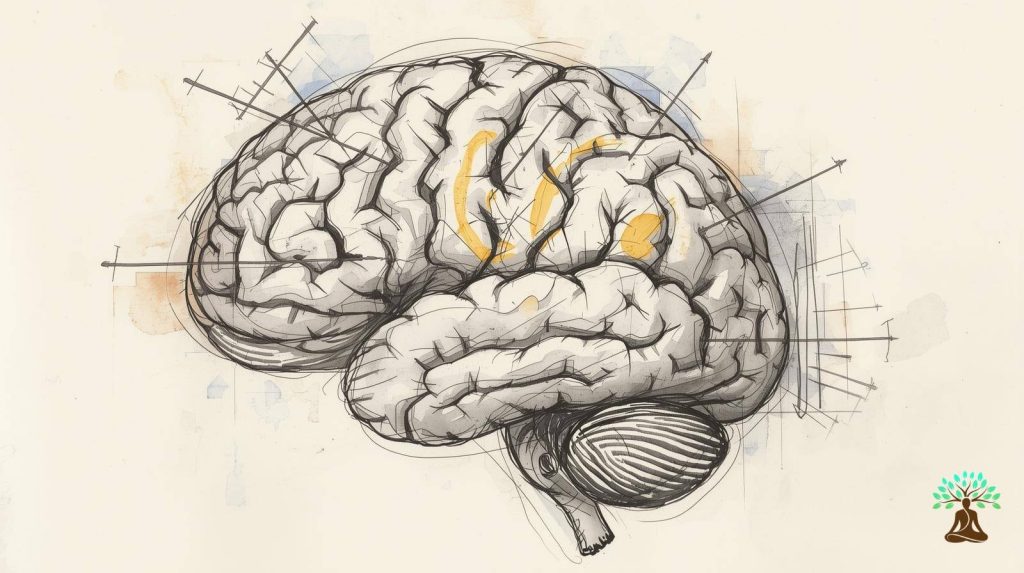
That said, I’m slightly wary of calling it the brain’s ‘rational centre’ or ‘brake pedal’, though, because that makes the whole thing sound as if there’s one sensible bit at the front desperately trying to control all the unruly emotional bits behind it. The brain is much more interconnected than that, and mindfulness seems to involve changes in how several of those systems communicate rather than simply making one region stronger.
There is some interesting evidence here, too. In one randomised study, researchers found increased connectivity between the dorsolateral prefrontal cortex (an important part of the executive-control network) and other regions involved in cognitive control after a short period of intensive meditation training. Broader reviews have also found changes involving prefrontal networks, although the results across studies aren’t consistent enough for me to confidently say that meditation simply “strengthens the prefrontal cortex”.
And this is where the plot really thickens. It’s no longer just about keeping your focus glued to the breath. That same core skill we’ve been tracking this whole time – noticing what your mind is doing before you accidentally get swept away by it – applies just as much when what grabs your attention isn’t a harmless wandering thought, but pure irritation, frustration, anxiety, or the sudden urge to bite someone’s head off.
During meditation, that might mean noticing the itch you desperately want to scratch, the thought you’re about to chase, or the urge to give up and check how long is left on the timer. Outside meditation, it might be catching yourself halfway through composing an unnecessarily angry reply, noticing that you’re winding yourself up before an awkward conversation, or recognising that familiar pull towards an argument you already know probably isn’t going anywhere useful.
To be clear, this doesn’t mean you magically turn into a serene, unflappable monk every time someone cuts you off in traffic (wouldn’t that be nice!), but even a micro-gap between your initial impulse and what you actually do next can change everything. Especially during conversations where the very first thing your brain wants to say is best left buried forever.
This is also where mindfulness crosses paths with other topics we cover. Our guide to mindful communication is basically a masterclass in using that tiny pause before reacting, while our piece on meditation for difficult emotions tackles what happens when the distraction is internal rather than from someone else.
So, I wouldn’t go as far as saying mindfulness installs a brand-new brake pedal in your brain. It’s more like reps at the gym – practice in realising that there’s always a tiny, fleeting moment between feeling an impulse and acting on it, even if, at first, that moment is so small you almost miss it.
The Amygdala | Mindfulness and Emotional Reactivity
That little gap between feeling an emotion and instantly reacting to it gets even more fascinating when anxiety enters the room. Because this is usually where the star of every meditation-and-the-brain article makes its grand entrance, and that’s the amygdala.

You’ll often see it labeled as the brain’s “fear center”. Which is a handy shorthand, but makes it sound like a literal panic button wired into your skull. In reality, the amygdala’s job is broader – it processes emotionally charged information and flags the things that matter enough for the rest of your brain and body to wake up and pay attention.
When something feels like a threat (whether it’s a bear on the trail or a passing thought about a deadline next week) the reaction is blindingly fast. Your focus tunnels, your body shifts into gear, and suddenly whatever sparked the panic feels like the absolute center of the universe. If you’re anything like me, you already know that simply telling yourself to “calm down” is about as useful as it sounds.
This is where mindfulness gets genuinely interesting, though usually not for the reasons you’ll find online. The classic myth is that building a daily meditation habit shrinks a hyperactive amygdala while bulking up the logical prefrontal cortex, essentially ripping the steering wheel away from the panic button and handing it back to your rational mind. There are bits of data that flirt with that idea, but it’s far from definitive.
Take a study that compared folks finishing an eight-week MBSR course against an active control group, while also looking at long-term meditators. After eight weeks, the researchers didn’t find that the mindfulness group had simply silenced their amygdala responses to negative images. Instead, they found stronger functional connectivity between the amygdala and the ventromedial prefrontal cortex, which is the region that helps evaluate and regulate emotional cues.
And I actually think that makes the finding more relevant, because it shifts the question away from “can meditation make the fear part of my brain shut up?” and towards something much closer to the thread we’ve been following throughout this article – what changes in the way different parts of the brain work together when something grabs our attention?
It also makes more sense to me when I think about my own personal struggle with anxiety over the years… Mindfulness hasn’t stopped anxious thoughts from appearing, and it definitely hasn’t made the associated unpleasant physical sensations disappear. But what it does sometimes give me is a better chance of noticing what’s happening before the thought, the sensation and the story I’m telling myself about both of them all bundle into one giant, overwhelming ball of dread in my stomach.
The goal isn’t to train yourself into some emotionless void where you never feel fear. For one thing, that’s impossible, and for another, fear is there for a reason. It’s more about becoming a little less likely to automatically pour gasoline on the fire once it starts. Broader research does show that mindfulness helps dial down anxiety symptoms, even if scientists are still mapping out the exact plumbing behind it.
If anxiety is the reason you came to mindfulness in the first place, we’ve got a much more practical guide to meditation for anxiety which might help you find some relief. But from the neuroscience side, I think the important point is that mindfulness probably isn’t teaching one frightened bit of the brain to calm down. It appears to involve changes across the wider systems involved in noticing, evaluating and regulating what we feel, which is a much less catchy explanation, admittedly, but probably a more accurate one.
The Insula | Noticing What’s Happening Inside Your Body
Up to this point, we’ve mostly looked at what happens when something grabs our attention. But anxiety is a great reminder that thoughts are only half the story. Honestly, I usually notice something the physical affects in my body long before my brain catches up… My chest gets tight, my breathing shifts, I realize I’ve been clenching my jaw like a bulldog for ten minutes, or my shoulders are somehow creeping up toward my ears.
That ability to sense what’s happening inside the body is known as interoception, and one of the brain regions that comes up repeatedly in the research is the insula.
The insula is basically our internal switchboard, processing signals about breathing, heart rate, temperature, pain, and all kinds of other physical sensations. It also helps translate those raw physical sensations into actual emotional feelings. It isn’t some sort of standalone ‘body awareness center’ (mainly because the brain stubbornly refuses to organize itself into convenient little boxes) but the insula is definitely a heavy hitter in the network.

And suddenly, practices like body scan meditation start making a whole lot more sense. You’re intentionally dragging your focus away from the endless monologue in your head and planting it right in your physical reality – pressure, warmth, tension, the movement of the breath, or that one itch you now desperately wish you hadn’t noticed.
Do that often enough and it’s reasonable to wonder whether it actually make you better at tuning into your internal signals.
The short answer is yes, though with a few caveats. A recent meta-analysis of 29 randomized controlled trials with over 2,000 people found a small-to-moderate boost in self-reported interoception after mindfulness training. Crucially, that means people felt a real shift in how they noticed and related to their body’s signals – not necessarily that they suddenly gained a superhuman radar capable of detecting every single heartbeat or fluctuation in body temperature.
The brain-scan data is pretty interesting, too. A systematic review of fMRI studies found that increased insula activity is one of the most consistent changes that appear after a structured mindfulness course. In another study, folks dealing with anxiety or depression showed heightened activity in the anterior insula while deliberately focusing on their heartbeat after eight weeks of mindfulness training.
Put it all together, and nobody is claiming meditation turns you into a human lie detector or gives you medical-grade internal diagnostics. What it does do is make it entirely plausible that practicing this kind of attention helps us catch signals that were probably whispering away in the background all along.
This becomes even more interesting once emotions enter the picture, because they rarely exist purely as thoughts. Anxiety drops in as a tight chest or shallow breathing, stress shows up in knotted muscles, and irritation can build in your body long before you consciously realise you’re about to snap.
For me, that’s where interoception stops being just another dry science term. By the time my conscious brain finally mumbles, “Ah, I’m feeling anxious”, my body has usually been waving warning flags for a while. Mindfulness doesn’t magically stop those physical reactions from happening, but getting familiar with them gives you a fighting chance to notice what’s going on before the physical sensation, the anxious thoughts, and the dramatic movie your mind builds around it all blend into a giant panic soup.
There’s a massive gap between catching “ah, there’s that familiar tightness in my chest” versus riding that wave for ten minutes until your brain decides it’s a medical emergency. The sensation might still be totally uncomfortable, but at least you caught it early enough to keep a little breathing room between the physical feeling and the story your mind wants to attach to it.
If physical stress is your personal brand of kryptonite, our guide on meditation for stress relief dives deeper into how to work with that practically. But for our purposes here, the insula gives us another puzzle piece: mindfulness might not stop stress, tough feelings, or weird bodily sensations from crashing the party, but it helps us spot them while they’re actually happening, instead of after they’ve taken over the house.
Mindfulness doesn’t separate the mind from the body; it reconnects them. And the insula seems to play a big part in that reconnection, helping awareness move out of abstract thinking and into lived, physical experience. When that happens, emotions become easier to work with, because they’re no longer just thoughts in your head. They’re sensations you can notice, allow, and let pass.
Does Mindfulness Actually Change the Brain Over Time?
We’ve all heard this magic word drop the second mindfulness comes up in conversation: neuroplasticity.
It’s usually the cue for someone to lean in and tell you meditation can literally “rewire your brain”. Sounds amazing, right? Just sit quietly for a few weeks, focus on the old inhale-exhale, and suddenly your internal machinery upgrades itself into something Zen, razor-sharp, and completely immune to those 2:00 AM cringe-shivers about that awkward thing you said when you were 15.
However, to be fair, there’s real science hiding underneath the hype. Neuroplasticity just means the brain can change and adapt based on what we experience, learn, and repeat – and thankfully, that superpower doesn’t just shut off the day we mature into adulthood. So when scientists started spotting differences in the brains of regular meditators, asking whether meditation itself was driving those changes was a completely reasonable question.

And honestly, the early results were pretty exciting.
Take a famous 2011 study that scanned people before and after an eight-week Mindfulness-Based Stress Reduction (MBSR) course. It reported a noticeable bump in grey-matter concentration in a few brain regions, including the left hippocampus. Naturally, it didn’t take long for that to break out of the academic journals and morph into the punchy headline we all know: Eight weeks of mindfulness changes your brain’s structure.
I completely understand why that caught on, and I bought into it too when I first started reading about this stuff. There’s something deeply satisfying about the mental image of your brain physically reshaping itself block by block every time you sit down on the cushion.
But the catch is that the original study was tiny, with only 16 people finishing the mindfulness program. It doesn’t mean the results were garbage, but it does mean it’s the kind of spark you’d want to see replicated on a much larger scale before you start printing t-shirts.
Which, eventually, science did.
By 2022, a much bigger study was conducted, combining two randomized controlled trials with a total of 218 absolute beginners. They tracked grey-matter volume, density, and cortical thickness following another eight-week MBSR stint, focusing on the exact hotspots earlier studies had flagged.
The verdict? They didn’t find convincing evidence that the program had actually altered brain structure compared to the control groups. And honestly, I think that’s where the story gets even more interesting.
It would be easy to throw our hands up, call the original research a bust, and write off the whole ‘meditation changes your brain’ narrative as wellness fluff. But it’s not quite as simple as that, and these things tend to follow a similar pattern – small early studies throw out intriguing clues, bigger studies test them under a microscope, and over time we figure out what actually sticks and what quietly fades away.
A more recent look at MBSR neuroimaging research paints a very similar picture. Structural changes remain all over the map, with plenty of studies finding zero significant shift in grey matter. On the flip side, functional changes – meaning how different brain regions light up and chat with one another – look a lot more consistent.
By now, that probably sounds familiar, because it’s the exact arc we’ve been tracking this whole time.
We started with the mind drifting away from the breath and that funny little jolt of realization when you catch it. From there, we looked at the default mode network, the internal alarm bells that spot distractions, how we handle emotional triggers, and our physical awareness of what’s happening under our skin. Time and again, the solid research points toward a shift in how these systems behave and work together, rather than meditation magically inflating or shrinking some isolated patch of grey matter.
Personally, I find that version a whole lot easier to live with anyway. When I sit down to meditate, I’m definitely not wondering if my hippocampus has stretched out by a fraction of a millimeter. What I actually notice is that I caught myself spiraling into a thought a little sooner than I used to, or that I felt anxiety bubbling up before it completely hijacked my day. Those aren’t flashy before-and-after brain-scan trophies, but they are tangible shifts you can actually feel in the middle of a your life.
It also makes you realize how silly the obsession with timelines is. Articles love the number “eight” because MBSR is an eight-week course, not because your brain hits day 56, hears a tiny digital chime, and flashes a REWIRE COMPLETE sign across your forehead.
If you’re trying to build a habit that actually lasts, our guide on making meditation stick is probably a better use of your energy than counting down the days until your skull feels structurally upgraded.
So, does mindfulness change the brain over time? Probably, yeah, in certain ways. Neuroplasticity is real, and the evidence connecting meditation to changes in brain function and connectivity keeps getting stronger. What we don’t have is proof dramatic enough to promise that a few weeks of breathing exercises will reliably grow or shrink specific brain regions.
It’s not quite the sexy, overnight makeover story that gets shared a million times on social media, but for those of curious about the benefits of regular meditation, it is exciting nonetheless.
What the Science Doesn’t Say About Mindfulness
By now, I think we’ve safely established that mindfulness definitely tinkers with the brain – just not in the neat, magical, overnight-makeover way the internet loves to preach. And that nuance matters, because the second something earns the badge of being “scientifically proven”, people start tacking every miracle claim under the sun onto it.
Meditation sharpens your focus. Meditation cures anxiety. Meditation changes the brain. Meditation slays stress. Before you know it, you’re only a few clickbait headlines away from the promise that sitting quietly for ten minutes with your eyes closed will fix your sleep, your mood, your blood pressure, your relationships, and probably boost your home Wi-Fi.
The actual data is a lot more nuanced than that.
There are definitely arenas where mindfulness looks genuinely promising, especially around stress, anxiety, and depression. But even there, the results heavily depend on what kind of program was run, who signed up, what it was stacked against, and how the researchers measured success. Even the US National Center for Complementary and Integrative Health (NCCIH) points out that while some findings are genuinely encouraging, a lot of the evidence is still preliminary, patchy, or hard to untangle because study designs are all over the place.
That’s always worth keeping in the back of your mind whenever you spot a headline starting with “Science proves mindfulness…” followed by something wildly specific.
It’s also worth remembering that meditation isn’t a silver bullet for literally everyone. Sure, most people coast through mindfulness practices just fine, but adverse reactions do happen – they just rarely get as much airtime as the benefits. Research reviews have flagged spikes in anxiety, low mood, or general distress in a minority of people, and scientists are still figuring out who might be more vulnerable to that kind of friction. The NCCIH notes that safety research is still pretty thin, which is a hell of a lot more honest than pretending breathing exercises are 100% risk-free just because they don’t come in a prescription bottle.
We’ve tackled that side of things in our guide on whether meditation is safe for everyone, but it deserves a spot in the science chat, too. If we’re going to talk honestly about evidence, we have to own the messy parts.
The same goes for mental health care. Mindfulness can be an amazing sidekick alongside therapy, medication, and professional support, and clinical programs use it all the time. But that doesn’t turn meditation into a substitute for a doctor or a therapist. If someone is drowning in severe anxiety, trauma, depression, or anything heavily impacting their life, I’d be dubious of anyone whose only advice is, “You just need to meditate more”.
Plus, more meditation doesn’t automatically mean better meditation. An older version of this article claimed that short, daily sessions somehow hack your brain more efficiently than longer, occasional sessions. But when I went looking for ironclad proof of that rule, I came up empty. Regular practice definitely matters, but science hasn’t handed us some universal formula where ten minutes a day beats thirty minutes twice a week, or where piling on more hours automatically guarantees more brain rewiring.
And honestly, I find the flexibility in that liberating. It means I don’t have to treat my meditation cushion like another corporate productivity tracker where I’m stressing over whether I logged enough minutes, used the optimal technique, or unlocked the right neurological upgrade. If I’m practicing consistently enough to actually notice a shift in how I handle my thoughts, distractions, or bad moods, that matters a whole lot more to me than some influencer telling me I need to sit for forty-five minutes before breakfast.
And really, that’s the golden thread connecting everything we’ve looked at. The best case for mindfulness isn’t that it turns you into a perpetually serene Zen master with a newly engineered brain. It’s that regular reps can gently tweak how you handle attention, emotional waves, body signals, and how your brain networks talk to each other – even if scientists are still mapping out the exact dimensions and permanence of those changes.
That version of the story doesn’t fit very well on a pretty motivational quote card for Instagram, but it has one massive advantage: it’s actually true to what the science says.
Final Thoughts
After spending all this time poking holes in some of the bigger claims about mindfulness, I’ve actually walked away more fascinated by the science, not less.
The narrative that eight weeks of meditation reliably plumps up one part of your brain, shrivels another, and gently morphs you into a permanently tranquil, laser-focused superhuman is definitely easy to market. It just doesn’t happen to be where the strongest evidence points.
Instead, what keeps surfacing is something a whole lot subtler. Mindfulness seems to tweak the activity and cross-talk between brain networks that handle attention, mind-wandering, emotional regulation, and body awareness. Some data is rock-solid, other pieces are still up for debate, and that dramatic ‘structural rewiring’ story is nowhere near as tidy as the internet makes it out to be.
None of that makes mindfulness feel less valuable to me, though, because the changes I actually care about were never going to show up on a glossy before-and-after MRI scan anyway.
I care about waking up and realising my mind has hijacked my focus and bolted into some pointless mental rabbit hole before I’ve spent twenty minutes chasing it. I care about catching an anxious spiral while it’s still just a small spark, rather than after it’s completely swallowed me whole. And I care about carving out just enough breathing room between an impulsive thought and reacting to it, so I can realise I actually have a choice.
Those are tiny, quiet shifts, and they aren’t nearly as exciting or grandiose as claiming meditation has literally rebuilt my brain, but they’re also the exact things I can actually feel happening in my own busy, chaotic life.
And maybe that’s the best way to digest the science of mindfulness. We don’t need every over-hyped marketing claim to be gospel truth for the practice to matter. The data can be messy, studies can occasionally butt heads, and researchers can still be passionately arguing over the exact neural plumbing and yet mindfulness can still be a profoundly useful tool to put into practice.
If you’re ever wondering whether any of those subtle shifts are actually taking root in your own routine, our guide on the signs meditation is working looks at the subtle, everyday milestones I’d focus on long before worrying about what an MRI machine thinks of my brain.
Personally, I’ll happily take catching my own wandering mind a few seconds sooner over becoming a full-fledged Jedi master any day of the week.
Further Reading
If you’re thinking “great, but what do I actually do with this?”, we’ve got you covered:
